

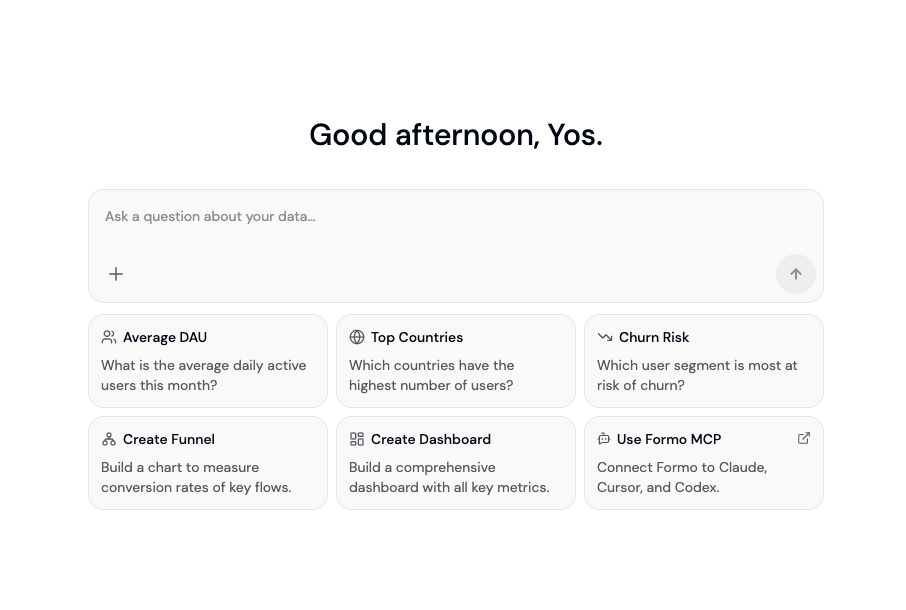
Open Ask AI to get started.
How it works
The Ask AI feature provides an intelligent analytics assistant that can:- Generate queries: Ask questions in natural language and get SQL queries automatically generated
- Explore patterns: Discover trends and patterns in your data that might not be immediately obvious
- Surface anomalies: Identify unusual behavior or outliers in your metrics
- Recommend actions: Get recommendations for what to do next based on your data
- Build charts: Create custom charts and save them to your dashboard
- Text to SQL: Write and fix SQL code based on your instructions
Access Ask AI
Use Ask AI from anywhere on the dashboard. Ask it any question about your data, or ask it to draw custom charts for your dashboard.Getting started
- Click Ask AI from anywhere in the dashboard
- Type your question in natural language, such as:
- “What are my top performing acquisition channels this month?”
- “Show me users who dropped off in the signup funnel”
- “Which wallets have the highest transaction volume?”
- “Are there any unusual patterns in my recent activity?”
- Review the generated query and results
- Save useful charts to your dashboard
Use cases
Data exploration
Ask AI can help you explore your data without needing to know SQL or complex analytics queries. Simply describe what you want to understand, and the AI will generate the appropriate analysis.Pattern recognition
The AI can identify trends, seasonality, and patterns in your user behavior, transaction data, and conversion metrics that might be difficult to spot manually.Anomaly detection
Get alerts about unusual spikes, drops, or changes in your key metrics, along with potential explanations for what might be causing them.Actionable insights
Ask AI provides context and recommended next actions based on what it finds, not just raw data.Best practices
- Be specific: The more specific your questions, the better the AI can help you
- Provide context: Mention time periods, user segments, or specific metrics you’re interested in
- Follow up: Ask follow-up questions to explore interesting findings further
- Validate insights: Always review the AI’s findings and validate important insights with your domain knowledge
- Specify time ranges: Use “in the last 7 days” instead of “recently”
- Name metrics clearly: Use “daily active wallets” instead of “users”
- Include thresholds: Use “net worth > $10,000” instead of “wealthy users”
- Ask for comparisons: Use “Compare X to Y” instead of “Show me X”
Sample questions
For a full list of example questions and prompts, see the How to use Ask AI guide.Memory
Memory is a set of durable facts that Ask AI recalls across every chat, so you don’t have to re-explain your product each time. Use it to store product context, metric definitions, naming conventions, and preferences that shape how the AI queries your data and answers questions.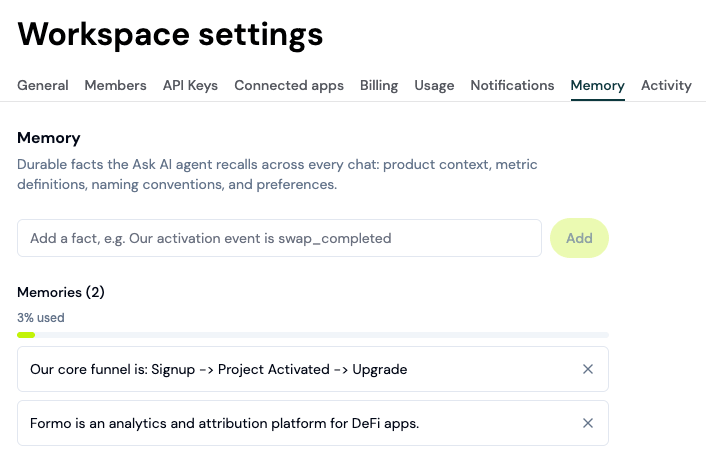
Manage memory in Workspace settings → Memory.
- Product context: “Formo is an analytics and attribution platform for DeFi apps.”
- Metric definitions: “Our activation event is
swap_completed.” - Funnels and naming: “Our core funnel is: Signup → Project Activated → Upgrade.”
- Preferences: default time ranges, the segments you care about, or how you want results formatted.
Manage your memory
- Go to Workspace settings → Memory
- Type a fact in the Add a fact field and click Add
- Remove a fact anytime with the × next to it