> ## Documentation Index
> Fetch the complete documentation index at: https://docs.formo.so/llms.txt
> Use this file to discover all available pages before exploring further.
# Attribution
> Learn why onchain attribution matters for sustainable growth and how Formo attributes conversions from first click to wallet transaction.
### Overview
User acquisition is one of the biggest problems in crypto.
For an app to succeed, it must have **sustainable unit economics** when it comes to user acquisition.
The lifetime revenue of a user (LTV) should be greater than the cost to acquire them (CAC) at a healthy multiple.
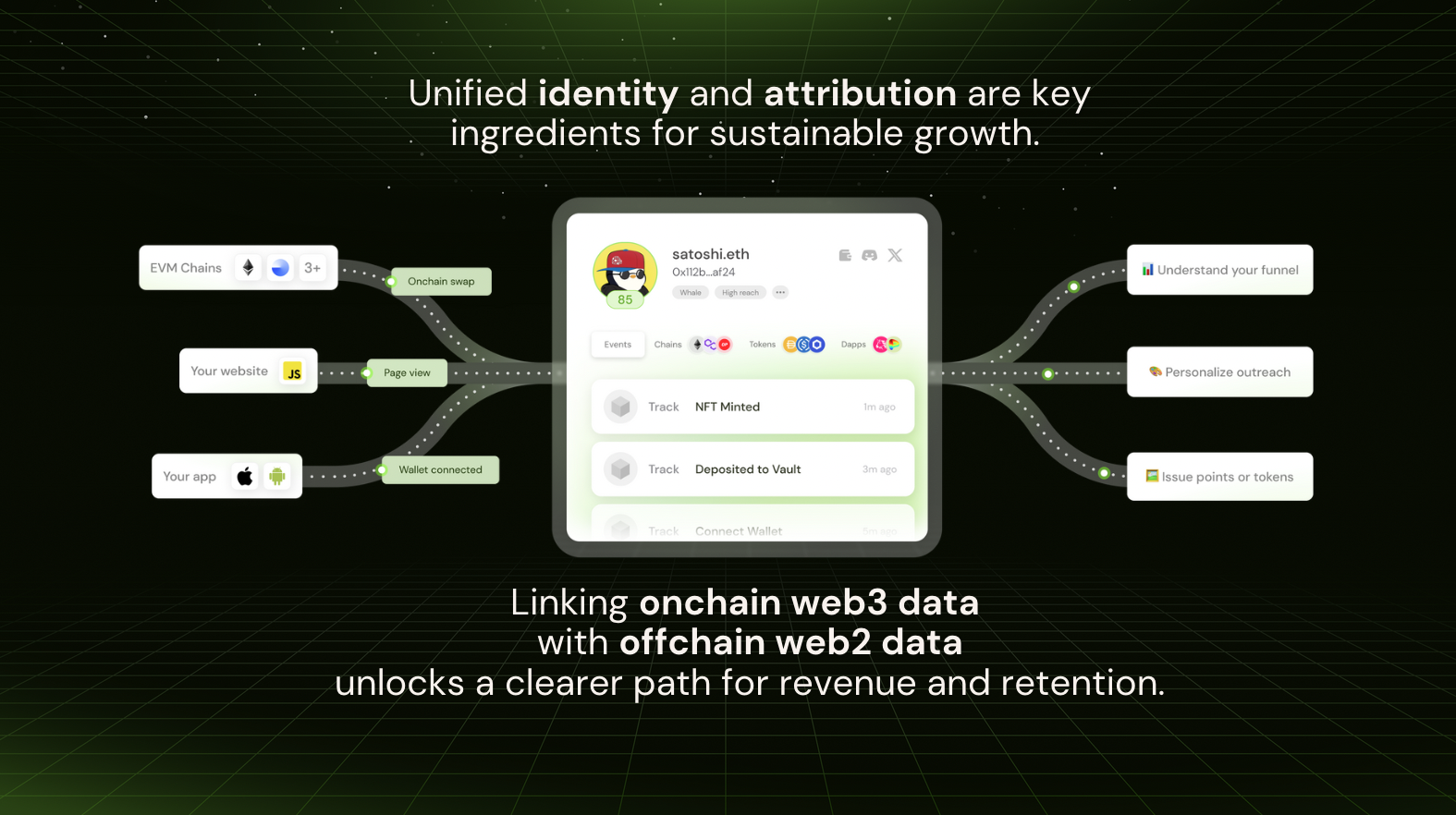 Without accurate attribution, you are lost in the dark forest.
Attribution helps answer:
* Where did users come from?
* What meaningful activity did users perform on my app?
* How well are users monetizing? How much revenue did I make? (ARPU, LTV)
* How long are users sticking around? (Retention, Churn)
* Is my ROI for an acquisition channel positive? (LTV > CAC)
### Example
Attribution in web3 is *complex*.
Consider the following example user journey for a DEX called FooSwap with many touchpoints:
* A user sees a tweet thread about an app on X (*"referrer"*) clicks on a referral link
* The user visits the app's website (fooswap.com)
* The user visits the app (app.fooswap.com)
* The user connects their wallet on the app
* The user signs a token approval message
* The user starts a swap transaction but the wallet has insufficient gas
* The user abandons their transaction (*"dropoff"*)
* The user revisits the app from another channel on Farcaster (*"referrer"*)
* The user completes a swap transaction (*"conversion"*) emitting an onchain event
As you've seen in the above example, not everything you care about is onchain. In this example, two touchpoints contribute to the successful conversion: X and Farcaster. Using an [attribution model](/data/attribution#attribution-models), we can determine which touchpoint to credit for the conversion:
* Using the first-touch model, the complete conversion is attributed to X and the referral
* Using the last-touch model, the complete conversion is attributed to Farcaster
### How attribution works in Formo
To understand the full user journey, **we must navigate two different worlds: offchain and onchain.**
It's imperative to trace the event sequence from initial engagement offchain to conversion onchain.
Here's a high-level overview of how it works:
```mermaid theme={null}
sequenceDiagram
participant User
participant Website
participant App
participant Wallet
participant Chain
participant Formo
note over User,App: Detect timezone, UTM, referrer, referral
activate Formo
%% Session start
User->>App: visit (via links / ads / campaigns)
Website->>Formo: record session, wallet events, and offchain context
note over Website,Wallet: Detect wallet address, rdns provider, identity
note over Wallet,Formo: Index transactions, wallets, contracts
User->>Wallet: connect wallet
Formo->>Wallet: index wallet
activate Wallet
Wallet-->>Formo: record wallet metadata & activity
deactivate Wallet
Formo->>Formo: identity resolution
User->>Wallet: sign transactions
App->>Chain: contract calls (e.g. swap, mint, stake)
Formo->>Chain: index contract events
activate Chain
Chain-->>Formo: record tx receipt and logs
deactivate Chain
Formo->>Formo: match txs with context
Formo->>Formo: calculate attribution
Formo-->>App: unified identity and attribution for apps
Formo-->>User: wallet-aware personalized experiences for users
deactivate Formo
```
Formo solves two core functions: attribution and identity.
* **Attribution** refers to [event-based analytics](/data/events/overview) about where, how, and when users interact with links, sites, and apps (touchpoint trackers, UTM & referral parameters, events, ingestion).
* **Identity** refers to the resolution of user activity into a single [unified profile](/features/wallet-intelligence/wallet-profiles) (sessions, demographics, wallets, onchain data).
Spend less time building analytics and leave the complex data engineering to us.
### Attribution models
Formo helps you understand the impact of touchpoints in each user journey using single-touch attribution, crediting either the first or the last touchpoint within the lookback window.
| Model | Description |
| :---------- | :------------------------------------------------------------------------------- |
| First Touch | Gives 100% credit to the first touchpoint within the attribution lookback window |
| Last Touch | Gives 100% credit to the last touchpoint within the attribution lookback window |
> Looking for more attribution models? [Let us know](mailto:support@formo.so).
### Glossary
| Term | Definition |
| :-------------- | :----------------------------------------------------------------------------------------------------------------------------------------------------------------------------------------------------------------------------------------------- |
| User journey | Consists of touchpoints and the conversion event. It is possible for a conversion event to have no corresponding touchpoints (eg. utm parameters). In this case we consider it a 'direct' conversion |
| Conversion | The primary event you're interested in attributing. Typically a volume or revenue generating conversion event such as "Mint" or "Swap" or "Stake". |
| Touchpoint | Actions (events) a user's taken or exposed to along the journey before doing the conversion event. \[Eg. does event A → B → C → D (conversion event) in a 7 day period; For a lookback window of 7 days, A, B, C are all considered touchpoints] |
| Lookback window | The time window where a user's events with this attribution property are counted towards the calculation. The window ends when the conversion metric happens. |
Without accurate attribution, you are lost in the dark forest.
Attribution helps answer:
* Where did users come from?
* What meaningful activity did users perform on my app?
* How well are users monetizing? How much revenue did I make? (ARPU, LTV)
* How long are users sticking around? (Retention, Churn)
* Is my ROI for an acquisition channel positive? (LTV > CAC)
### Example
Attribution in web3 is *complex*.
Consider the following example user journey for a DEX called FooSwap with many touchpoints:
* A user sees a tweet thread about an app on X (*"referrer"*) clicks on a referral link
* The user visits the app's website (fooswap.com)
* The user visits the app (app.fooswap.com)
* The user connects their wallet on the app
* The user signs a token approval message
* The user starts a swap transaction but the wallet has insufficient gas
* The user abandons their transaction (*"dropoff"*)
* The user revisits the app from another channel on Farcaster (*"referrer"*)
* The user completes a swap transaction (*"conversion"*) emitting an onchain event
As you've seen in the above example, not everything you care about is onchain. In this example, two touchpoints contribute to the successful conversion: X and Farcaster. Using an [attribution model](/data/attribution#attribution-models), we can determine which touchpoint to credit for the conversion:
* Using the first-touch model, the complete conversion is attributed to X and the referral
* Using the last-touch model, the complete conversion is attributed to Farcaster
### How attribution works in Formo
To understand the full user journey, **we must navigate two different worlds: offchain and onchain.**
It's imperative to trace the event sequence from initial engagement offchain to conversion onchain.
Here's a high-level overview of how it works:
```mermaid theme={null}
sequenceDiagram
participant User
participant Website
participant App
participant Wallet
participant Chain
participant Formo
note over User,App: Detect timezone, UTM, referrer, referral
activate Formo
%% Session start
User->>App: visit (via links / ads / campaigns)
Website->>Formo: record session, wallet events, and offchain context
note over Website,Wallet: Detect wallet address, rdns provider, identity
note over Wallet,Formo: Index transactions, wallets, contracts
User->>Wallet: connect wallet
Formo->>Wallet: index wallet
activate Wallet
Wallet-->>Formo: record wallet metadata & activity
deactivate Wallet
Formo->>Formo: identity resolution
User->>Wallet: sign transactions
App->>Chain: contract calls (e.g. swap, mint, stake)
Formo->>Chain: index contract events
activate Chain
Chain-->>Formo: record tx receipt and logs
deactivate Chain
Formo->>Formo: match txs with context
Formo->>Formo: calculate attribution
Formo-->>App: unified identity and attribution for apps
Formo-->>User: wallet-aware personalized experiences for users
deactivate Formo
```
Formo solves two core functions: attribution and identity.
* **Attribution** refers to [event-based analytics](/data/events/overview) about where, how, and when users interact with links, sites, and apps (touchpoint trackers, UTM & referral parameters, events, ingestion).
* **Identity** refers to the resolution of user activity into a single [unified profile](/features/wallet-intelligence/wallet-profiles) (sessions, demographics, wallets, onchain data).
Spend less time building analytics and leave the complex data engineering to us.
### Attribution models
Formo helps you understand the impact of touchpoints in each user journey using single-touch attribution, crediting either the first or the last touchpoint within the lookback window.
| Model | Description |
| :---------- | :------------------------------------------------------------------------------- |
| First Touch | Gives 100% credit to the first touchpoint within the attribution lookback window |
| Last Touch | Gives 100% credit to the last touchpoint within the attribution lookback window |
> Looking for more attribution models? [Let us know](mailto:support@formo.so).
### Glossary
| Term | Definition |
| :-------------- | :----------------------------------------------------------------------------------------------------------------------------------------------------------------------------------------------------------------------------------------------- |
| User journey | Consists of touchpoints and the conversion event. It is possible for a conversion event to have no corresponding touchpoints (eg. utm parameters). In this case we consider it a 'direct' conversion |
| Conversion | The primary event you're interested in attributing. Typically a volume or revenue generating conversion event such as "Mint" or "Swap" or "Stake". |
| Touchpoint | Actions (events) a user's taken or exposed to along the journey before doing the conversion event. \[Eg. does event A → B → C → D (conversion event) in a 7 day period; For a lookback window of 7 days, A, B, C are all considered touchpoints] |
| Lookback window | The time window where a user's events with this attribution property are counted towards the calculation. The window ends when the conversion metric happens. |